
The Anchorage Illusion

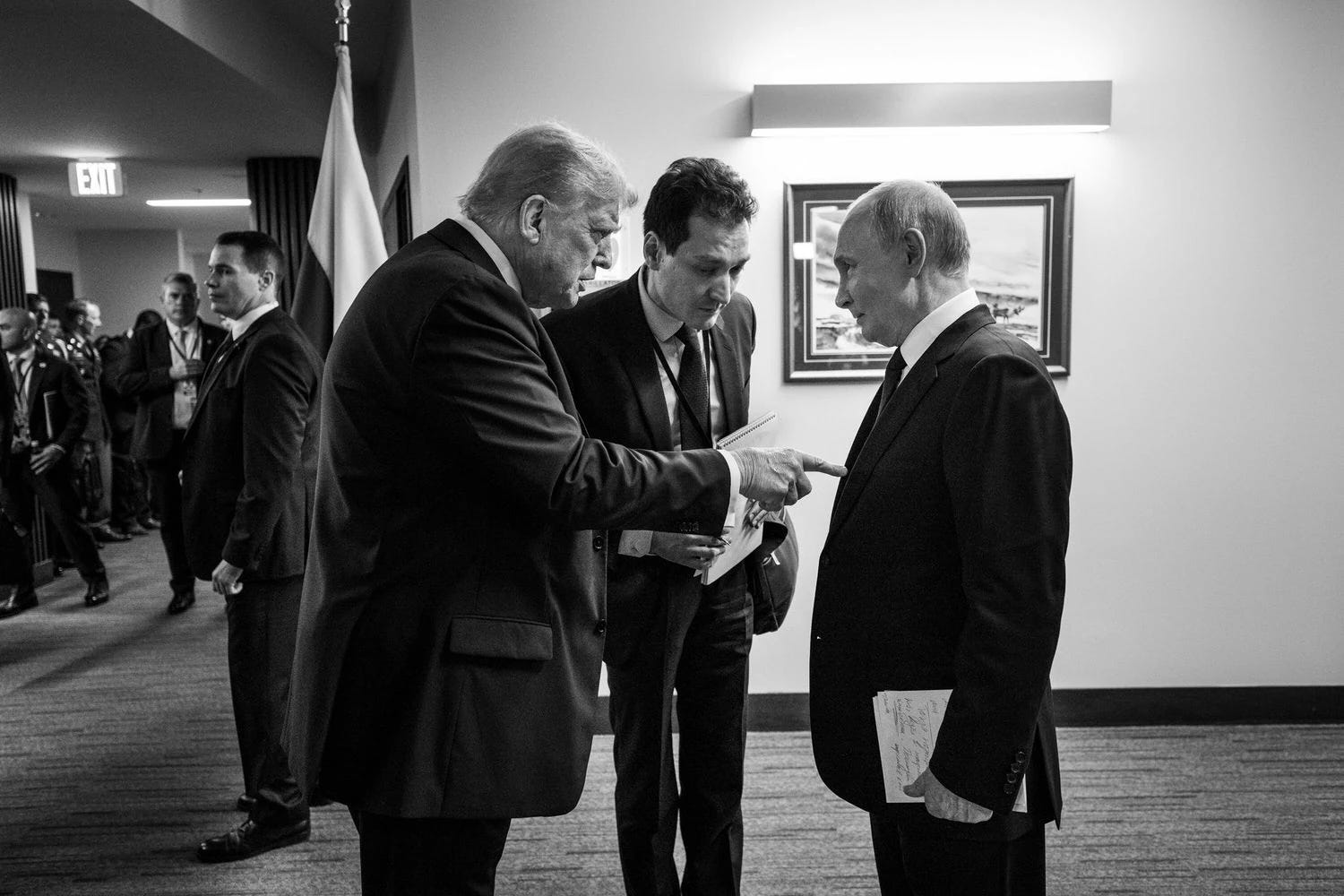
Much has been sealed with a handshake: the Good Friday agreement that finally silenced the Ulster guns, Begin and Sadat’s improbable reconciliation at Camp David under Jimmy Carter’s steadfast gaze, even Rabin’s hesitant clasp with Arafat on the White House lawn. In the synapse between meeting palms the weight of history seems to bend a little toward justice. Yet as Donald Trump and Vladimir Putin met on the tarmac of Joint Base Elmendorf-Richardson in Anchorage on Friday, they enacted a vastly different spectacle. Political theatre or Trump’s own brand of pageantry, it is hard to imagine a more effusive welcome for the Russian president. Complete with red carpets unfurled by kneeling airmen and B-2 bombers performing a choreographed flypast, America rolled out its finest. What’s been conspicuously absent amid the showmanship is any sort of substance. No sanctions, no mention of a ceasefire, not even the pretence of a ‘deal’.
Modern great-power competition hinges as much on perception as on material capabilities. Trump’s stated goal was an enforceable ceasefire, yet he departed Anchorage offering only “comprehensive negotiations” and pledging to call Ukraine’s and NATO’s leaders for their reactions. Months of preparatory talks about secondary sanctions to choke off Russian energy revenues seem to have been abandoned. What appears like a minor rhetorical pivot is, in fact, Putin’s most consequential victory. In recasting three years of hostilities and civilian loss as an indefinite European security dialogue, Putin de facto legitimises his battlefield tactics. Since 2014 the Kremlin’s playbook has relied on patience snd incremental pressure, a doctrine that has delivered 593 square kilometres of territory in just 30 days, according to The Economist’s estimate. With each successive week of indeterminate “talks,” Ukrainian positions weaken while Moscow consolidates its gains. Russia’s narrative victory, portrayed by state media as a “reset” in diplomatic relations, has already proved more durable than any sanctions package.
Putin has been a masterful manipulator of Trump’s vanities and Nobel Peace Prize aspirations. Where other leaders have face the president’s wrath for perceived slights, Putin has consistently received dispensation from his proclaimed “dear neighbour”. In diplomacy, as in physics, every action has an equal and opposite reaction. Trump’s pattern of abandoning alliance positions to accommodate authoritarian flattery has become a predictable vulnerability. Familiar from Trump’s North Korean overtures, the mismatch between presidential rhetoric and diplomatic reality is one that adversaries exploit with increasing sophistication. For the Russian delegation, the Alaska summit represented the culmination of a months-long campaign to rehabilitate international standing while avoiding any meaningful concessions. Russian state television broadcast images of the two leaders exchanging jovial remarks and sharing Trump’s armoured limousine, powerful visual narratives that undermine three years of Western efforts to isolate the Kremlin. Deliberate invocations of Alaska’s Russian heritage in Putin’s press address transformed American soil into a nostalgic backdrop for Russian imperial ambitions. Trump’s own post-summit comments describing Russia as “a big power” while dismissing Ukraine’s comparative strength signals a fundamental shift in strategic thinking that European allies will struggle to accommodate. Empty praise of the summit as “extremely productive” reverberated hollowly over a Europe braced for new offensives. Putin’s pre-summit offensive was no coincidence. In the week preceding Anchorage, Russian forces accelerated their advance near Dobropillia and Pokrovsk, seizing another 76 square miles. In July alone the Kremlin unleashed 6,200 drones, alongside thousands more decoys to overwhelm air defences. Meanwhile, Ukraine’s interceptor stocks have been stretched thin, with commanders warning that at current consumption rates their remaining Patriot and NASAMS rounds will be exhausted by mid-October. Even as the two presidents posed side by side for the cameras, Ukrainian defenders reported unrelenting frontline attacks.
Europe, by contrast, has refused to remain idle. Public opinion across the continent has finally hardened in favour of decisive action. European direct-contract aid to Ukraine (€4.6 billion in the May–June cycle) has already surpassed U.S. sales-based support. Within 72 hours of Anchorage, Brussels sanctioned 25 more Russian financial institutions and six oligarchs, accelerating work on its 19th package to target Moscow’s shadow fleet and high-tech exports. European Commission officials have also explored tapping €190 billion in frozen central-bank assets to bankroll Ukraine’s defence and hedge against further inaction in Washington. Short-term arms relief has also accelerated, with Germany financing new Patriot systems and France deploying its own EU-led task force. Across the Channel, Britain’s Keir Starmer met with Zelenskyy on Thursday to pledge his party’s unequivocal support for Ukrainian sovereignty. So far, Ukraine’s financial markets have responded with cautious optimism. Sovereign bonds maturing in 2029 rallied from 62 to 67 cents on the dollar in the aftermath of Anchorage, buoyed by expectations that European coordination would offset Trump’s deference.
As Zelenskyy’s delegation touches down in Washington on Monday, the moment calls for a decisive shift from ceremony to commitment. Flanked by the ‘Coalition of the Willing’, he will be joined by Sir Keir Starmer, France’s Emmanuel Macron, Italy’s Giorgia Meloni and Germany’s Olaf Scholz. Behind closed doors, Zelenskyy will press for concrete deliverables. His front-line commanders report sectors held by skeleton crews, winter defense maps outline exposed cities left vulnerable without immediate replenishments, and supply arteries risk severance by drones. Binding delivery schedules activation of secondary sanctions on Russian energy and finance, and formal security guarantees that preclude any land swap scenarios pushed by Moscow are all on the negotiating table. The ultimate measure of success, however, will be whether America can translate its pomp into power.
Unwittingly, or perhaps captivated by his own theatrics, Trump abdicated his accumulated leverage at the Alaska summit. Putin departs with renewed channels of diplomatic engagement, a semantic reframing of conflict on Russia’s terms, and an international legitimacy long denied by sanctions. Yet this eclipse of American coercive power has catalysed European strategic autonomy, offering a blueprint for independent collective resilience. It is prime time for Washington’s spectacle to yield to substance.
It’s a good read
But in my opinion, and i don’t know if it was on purpose, but the vocabulary was a little bit intense
And if your aim was writing for the public to read then it’s wont be bad to simplify somethings
Just my opinion
But it was really informative for me 😌
Very well written. It was intense and I felt the tension and urgency.